

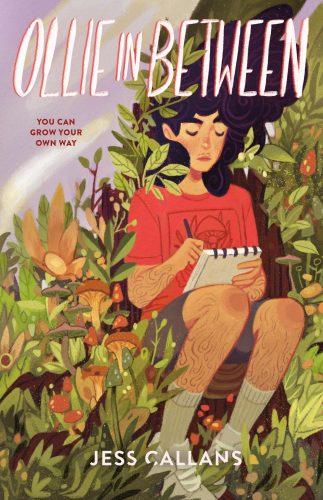
What a vital new thing Jess Callans has given us with his debut middle-grade novel, Ollie In Between. I took a long time to read it; the main character’s voice is so fresh, so resolutely original, that it left me both shaken and delighted. Every detail in this book feels tenderly thought out. The lush cover portrait shows Ollie with a sweet mustache and swirls of leg hair, at home amidst mushrooms and foliage. The title is at once understated and immovable, a manifesto.
This “modern take on Are You There God? It’s Me, Margaret” pays several loving tributes to that pioneering middle-grade novel. Judy Blume’s Margaret had one Christian and one Jewish parent and was pressured to choose a religion, despite being fine not identifying with one or the other. Ollie’s “in between” travails extend to being bicultural, non-binary, neither child nor adult. Do you recall Margaret’s rapturous initiation into the world of sanitary napkins? You will want to see Ollie’s take on that rite of passage. I won’t spoil it for you, but it’s a worthy addition to menarcheal canon.
Ollie In Between pays just as much loving tribute to Melissa, the pioneering middle-grade novel by Alex Gino. That book, itself, went through a name transition: it was first published under the main character’s deadname, then retitled properly. We see Ollie and their friends helping to correct the title on several copies at their local library.
Ollie is repelled by the tyranny of the narrative that children assigned female at birth are destined — doomed — to “bloom” into women. Apparently, though, puberty is coming with or without Ollie’s consent and cannot be averted. That crisis plays into a Cinderella plotline in this book, with Ollie paying visits to a special tree to connect with their late mother.
One of the most quietly effective devices in the book is Ollie’s way of taking note of something devastating with the thought, “It’s just an observation.” Ollie works hard to be what others expect: “borrowing” other people’s facial expressions and practicing them for appropriate occasions, concentrating on making eye contact. Perhaps my favorite Ollie trait is their ongoing rumination on natural phenomena, comparing themself to mantis shrimp, worms and bees, mycelia — a lot of invertebrates. It seems that Ollie has no trouble identifying as an organism; it’s human convention that exhausts them.
I told author Jess Callans how much I loved Ollie’s “neuroatypical digressions” and Callans told me he had taken care not to diagnose this character. He took care, as well, to write a story showing that there are many ways to be true to oneself, not a single “right” way to be a queer or non-binary middle schooler. Both the title character and the book are committed to that in-between openness rather than providing answers in a way that might close things off. For me, it’s that commitment in Ollie’s introverted, sometimes shaky, but always resolute voice that makes this book feel deeply respectful of middle schoolers and their complex thoughts. Look at the integrity in this passage from page 205. No one gets to define Ollie except Ollie.
You can’t defy nature. Well, not that much.
And so maybe I never blossom.
And so maybe I don’t need to.
Once a body has decomposed, it’s actually a great place for fungal growth. That sounds gross, I know, and maybe you don’t want to hear about it, but this is my story and it’s amazing to think about the way an entire once-alive person can become the food source for a whole network of other creatures.
So some people bloom, but fungi are way cool, too.
I recommend this book without reservation. Conscientious and original. A treasure.
*Extra bonus delight: the audiobook is narrated by Vico Ortiz! Yes, that Vico Ortiz!