

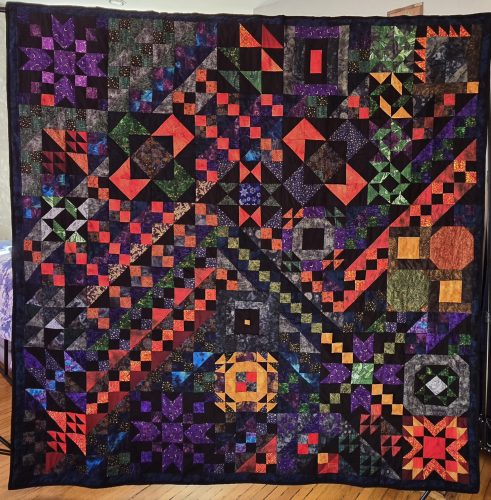
A textual but nonverbal argument delivered through the medium of a handmade patchwork quilt. Adapted from a presentation delivered at the Harry Potter Academic Conference at Chestnut Hill College, October 24, 2026.
In 2024, Patrick McCauley gave a presentation here that he characterized as following the structure of a quilt. This thrilled me, since I’m a quilter. I wondered if I could give a presentation as a quilt instead of a talk. Would the quilt medium provide different insights?
I challenged myself to present an argument that is textual – using textiles — but nonverbal. I’m going to explain how I used quilting vernacular to make my argument. Then I’ll discuss some conclusions I drew from interpreting the finished quilt as a graphic.
I argue that tracking the use of Expelliarmus can show us how Snape enabled two schoolboys to bring down the most powerful wizards of the era.
I used a grid of 7 feet by 7 feet, roughly one column for each of the books, tracing the plot chronologically from top to bottom, left to right.
I chose a code of eight colors:
- Purple is Dumbledore.
- Reds are Harry.
- Greens are Slytherin-ish; this green and silver print is Draco.
- Unstable gray is Voldemort.
- Dark blues and celestial prints are the enchanted ceiling of the Great Hall.
- Matte black is Snape. He looks like the background, but he’s in everything.
- Silver is the individual soul, the color of memories and Patronuses.
- Gold is the alchemical color of connection between people.
Column 1: Sorcerer’s Stone
Dumbledore starts the story in his signature purple with gold celestial accents. That little red square is Harry sleeping under the stairs.

The gray and green stretch around the first Dumbledore block is Privet Drive.

The red and black triangles are within a traditional pattern called Birds in Flight. It’s your basic Harry block.

The green, black, and silver is a traditional pattern called Windblown Square, your basic Draco block.

This block is called Wild Waves. The grays and greens show something ominous in the Forbidden Forest with the silvery dead unicorn at the center.

The purple-blue fabric with gold accent below has a print of jars. Combined with the matte black, this block refers to Snape’s potions puzzle guarding the Sorcerer’s Stone.

Here’s Harry again, but now with phoenix colors after he’s gotten the Sorcerer’s Stone.

Column 2: Chamber of Secrets
For Chamber of Secrets, this diagonal progression of blue batik squares is the Flying Ford Anglia.

This is a variation of a block called Card Trick. This is the Dueling Club, with Snape setting up Harry and Draco against each other to learn to Disarm instead of attack.

The green diagonal is the basilisk. The red diagonal beneath it is Fawkes flying everyone out of the Chamber of Secrets, and also the sword of Gryffindor.

Column 3: Prisoner of Azkaban
For Prisoner of Azkaban, here’s the second Dumbledore block, Dumbledore at his most omniscient, authorizing the Time-Turner travel.

Column 4: Goblet of Fire
Goblet of Fire starts with this Birds in Flight variation showing the Quidditch World Cup.

Here’s the Yule Ball with the snowflake fabric in the center.

This gray square with black and gold in the center is Voldemort after he has stolen Harry’s blood.

Unbeknownst to Voldemort, now that he contains love in his blood, he can connect to other people and feel the damage he’s done. His Avada Kedavra meets with Harry’s Expelliarmus in this red and gray four-patch and raises this golden dome of emotion around it, the first of three times that Voldemort’s magic connects with Harry and produces gold.

After Harry escapes the graveyard, Snape (depicted here with the blue and purple jar fabric) assumes his double agency and Dumbledore reconvenes the Order of the Phoenix (depicted here with the red, orange, and yellow print).

Column 5: Order of the Phoenix
This is a variation of a block called Courthouse Steps. This is Harry’s trial, where he sees the black door of his visions. Dumbledore is protecting Harry at this trial but not making contact with him.

This parallel to Dueling Club is when Harry transmits Expelliarmus to Dumbledore’s Army.

Here’s a stone-gray Pensieve holding Snape’s memories. Occlumency lessons, authorized by Dumbledore.

The Battle in the Ministry. Voldemort and Dumbledore fight, gray and purple. This red and gray four-patch, repeated from the golden dome block in Column 4, shows Voldemort possessing Harry. When he encounters this gold patch of Harry’s grief, though, it causes unbearable pain for Voldemort. From this point, he never goes into Harry’s mind again.

Column 6: Half-Blood Prince
Half-Blood Prince starts with this series of four Windblown Square blocks showing the Sad Ballad of Draco Malfoy, prince of Slytherin. He’s influenced first by Voldemort, in gray. Second, the gold shows the Unbreakable Vow protecting him with a mother’s love. Third, Dumbledore is watching over Draco but from a distance, in a more subdued purple. Fourth, Snape in black tries to guide Draco during sixth year.

This thick red diagonal is Harry learning to hunt Horcruxes in books 6 and 7.

The final Dumbledore block shows Draco at the center, calling on his long-ago Expelliarmus training (gold squares) to Disarm Dumbledore instead of attack him. The Elder Wand recognizes the power of disarmament and switches allegiance to Draco. The little red square is where Dumbledore has immobilized Harry to witness everything.

This Birds in Flight variation is the Flight of the Prince, with Snape hustling Draco out of Hogwarts while teaching Harry a final lesson.

Column 7: Deathly Hallows
A Fire on the Mountain motif surrounds Voldemort (unstable gray batiks) on two sides. A brown print depicting wandwood and a gold square show the second time Voldemort casts Avada Kedavra at Harry and produces gold, when Harry’s wand shoots flames at Voldemort.

This Twisted Knot block is Malfoy Manor when Harry Disarms Draco and wins the allegiance of both Draco’s wand and the Elder Wand. The magic of the two boys has become equivalent and interchangeable.

Here’s another Pensieve block, holding Snape’s memories from the Prince’s Tale chapter.

This final star, in a Memory block pattern, shows the third time Voldemort casts Avada Kedavra at Harry and produces gold. This is the culmination of the Expelliarmus storyline, when Harry uses Draco’s wand to restore Voldemort to mortality, claim the Elder Wand, and finally become fully and only himself.


The Billionaire Author
Once the quilt was finished, I was able to think about what it conveys as a material object. A queen-sized bedquilt is human-scale, meant to cover at least one person. I needed this to be big. During Rowling’s campaign of transphobia, which she funds with her fortune, I have struggled to come up with a simple graphic that conveys, at a glance, how much a billion dollars actually is. What are we up against? I couldn’t, for example, use a regular 8.5″ x 11″ sheet of paper to draw a line representing one billion and then mark a segment to represent one million; it wouldn’t be big enough to be visible. A pencil dot could represent ten million, but nothing smaller. I cannot imagine how my life would change if I got $10,000,000.
What about $100,000? Yes, that I could imagine.

This quilt is approximately 85 inches by 85 inches. Suppose the entire quilt represents one billion dollars. Do you see that tiny gold square in the lower half of the center column, representing Voldemort stealing Harry’s blood? That is $100,000. Your basic Harry block from Column 1 is a little less than $10 million. The four Draco blocks in Column 6 are a little less than $40 million.

As of 2025, according to Forbes magazine, JK Rowling’s net worth was $1.2 billion. So, imagine this quilt plus one fifth more. She earns $80 million per year from Harry Potter books, movies, theme parks, video games, and merchandise. That’s about the area of a Dumbledore block, the golden dome block, and the final phoenix Harry block put together.

I’ve felt frustration at online discourse pressuring people to boycott the upcoming HBO series so we can avoid funding transphobia. In this politically fraught time when we’re at risk of burnout, it’s vital to be strategic about where we put our precious limited energy for resistance. What are the various aims of a boycott, and which are achievable?
- If we personally feel gross giving money to the franchise, yes, boycott.
- If we want to support allies by letting them know we’re boycotting, yes, that will work.
- If we have a fantasy that we can collectively make this franchise unprofitable and thereby defund transphobia, I think that’s a long game that doesn’t address the monthly, sometimes weekly, timeline of attacks on trans rights. It’s necessary to understand the international scale of this franchise and how it’s profitable in other parts of the world for reasons that I cannot fathom as an Anglophone American.
- If we have a fantasy that our boycott can send a message to Rowling – that we can make her feel our sense of betrayal and endangerment – that we can somehow hurt her back – I think it is necessary to reframe. Billionaires don’t feel it. Billionaires do not hear us.
Three months ago, July 2026, Rowling used her wealth to bully Amnesty International into retracting an entire study because it called out one of her organizations for excluding trans people. That wasn’t on my TERFpocalypse bingo card. Amnesty International, where Rowling once worked, whose humanitarian worldview informs so much of Potterverse. The entirety of their global assets, across all member nations and organizations, is about $449,420,000, or about 37% of Rowling’s personal wealth. She can just do that.
The way Rowling and other transphobes manufacture political outrage by attacking public services for trans people is deeply, chillingly cynical. A friend of mine, a trans nonbinary academic who doesn’t want their name mentioned in anything to do with Harry Potter, showed me that National Services Scotland, for example, spends a total of $1.2 million per year funding gender reassignment surgeries. In proportion to Rowling’s total wealth, that would be about the size of the silver diamond in Snape’s Pensieve memories in Column 7. But that tiny sum of public health funding doesn’t reflect how many trans people there actually are. In the U.S., among people born between 1995 and 2004 – almost the same years that Harry Potter was published – 2.49% of the population identifies as transgender. That percentage would be equivalent to all the areas of gold fabric in this quilt.
America PAC, the anti-trans political action committee funded by Rowling’s ally Elon Musk, spent $100 million on these U.S. midterms alone. In terms of Rowling’s wealth, that’s equivalent to a strip across this entire quilt about 3.5 inches wide. Boycotting the HBO show is not going to defund transphobia anytime soon – not least because this show doesn’t even premiere until December 25. There’s got to be something we can do to fight two months’ worth of attacks on trans rights before then. Things we can actively do, in addition to attention or money that we can withhold.
It is important to understand the numbers, but there are powerful, urgently necessary things that don’t require wealth on Rowling’s scale. For example, take Trans Lifeline, a grassroots organization that runs a crisis hotline. In 12 years, they’ve answered over 150,000 calls. Their net assets are $7.6 million dollars. If this quilt represents that sum, the small golden square in Column 4 would be $760. That’s an achievable amount. A group of friends could hold a fundraiser and make a difference.
This year, depressed by current events, I decided doing something might make me feel better, no matter how small. I sold handmade octopod toys at a café to raise funds for Trans Masculine Advocacy Network, a local support group for Black and Brown Trans men. I felt ridiculous. They’re $12 apiece. Would that even make a difference? But the low amount turned out to be a strength. In one month, I raised $1500, selling to people lining up for their morning coffee after reading the day’s headlines who got a tiny lift of encouragement to see that there was one small way they could push back that day. Every $12 represented a stranger who cared. The group organizer wrote back, “This means more than a dollar amount. Black and Brown Trans men are often the last to receive funding, the last to be invested in, and the last to be seen when resources are distributed. This fundraiser is a reminder that our community can choose something different.”

Handmade fiber arts convey caring by their nature. When I look at how much emotion I put into this quilt, I see all the love and truth I associate with this series, and not even the present-day author can destroy that. Rereading what she wrote in pre-Brexit Britain brings the same kind of heartbreak I feel living in a country that used to welcome immigrants, that used to have an East Wing and a Rose Garden. For many people, boycotting Harry Potter is the right choice, but the story continues to reach new generations of schoolchildren. It’s not going anywhere in global culture. We still need these complicated conversations about engaging with it.
All of the things we wish we could tell JKR that she’ll never hear? The purpose of that bottled-up energy is to redirect it to talk to the people we can actually reach. According to the Human Rights Campaign, 85% of Americans believe in equal rights for trans people, an overwhelming majority. It costs nothing to speak that belief aloud, to counter the lie that transphobia is mainstream and inevitable. Once, I posted online about my fundraiser and someone criticized this as “performative.” Yes, it absolutely is. The Trevor Project found that over 90% of LGBTQ+ youth feel affected by the rise in anti-queer politics. It’s strengthening to learn that someone is on your side. Recall how Harry felt knowing people believed his interview in the Quibbler or hearing Potterwatch or seeing messages of support in Godric’s Hollow.
Recall Voldemort in the Final Battle, claiming, “Give me Harry Potter, and none shall be harmed.” Pansy Parkinson screamed, “Potter’s there! Someone grab him!” as though she were a politician who thinks scapegoating trans people is the way to stay in power. A mass of students rose to show Pansy just how many people knew better. Each person who stood up made it easier to disprove the lie. Even without wealth, if we speak the truth together, we do have the power to disarm.